
The Falcon-821CRH and Falcon-821CRS are 8MP 4K HDR USB 3.2 Gen1 cameras built on the Onsemi HyperLux AR0821 sensor, offered as a scalable OEM camera platform with VCM autofocus imaging in the CRH variant and fixed focus imaging in the CRS variant. Both models deliver 8MP (3848 × 2168) color rolling shutter output with dual-mode eHDR and LI-HDR, S-Mount (M12) lens compatibility, and UVC plug-and-play integration across Windows, Linux, and macOS. Target applications span document scanning, OCR imaging, identity verification, passport scanning, barcode reading, quality inspection, defect detection, robot guidance, pick and place automation, object tracking, and autonomous navigation.
FORT WORTH, TX / ACCESS Newswire / June 18, 2026 / Vadzo Imaging, a provider of embedded vision camera products, today introduces the Falcon-821CRS 4K HDR USB Camera and Falcon-821CRH 4K Autofocus USB Camera as a unified, scalable vision platform built on the Onsemi HyperLux AR0821 sensor. The two models form a dual-variant AR0821 camera module lineup sharing a common sensor foundation while offering distinct focus architectures: fixed focus imaging in the Falcon-821CRS and VCM autofocus imaging in the Falcon-821CRH. This dual-variant structure enables OEM engineering teams and system integrators to deploy the same AR0821 camera module baseline across applications with differing working-distance profiles-from fixed-mount document scanning, OCR imaging, and passport scanning stations to dynamic robot guidance, pick and place automation, and autonomous navigation platforms-without redesigning the imaging pipeline or transitioning to a different sensor platform.
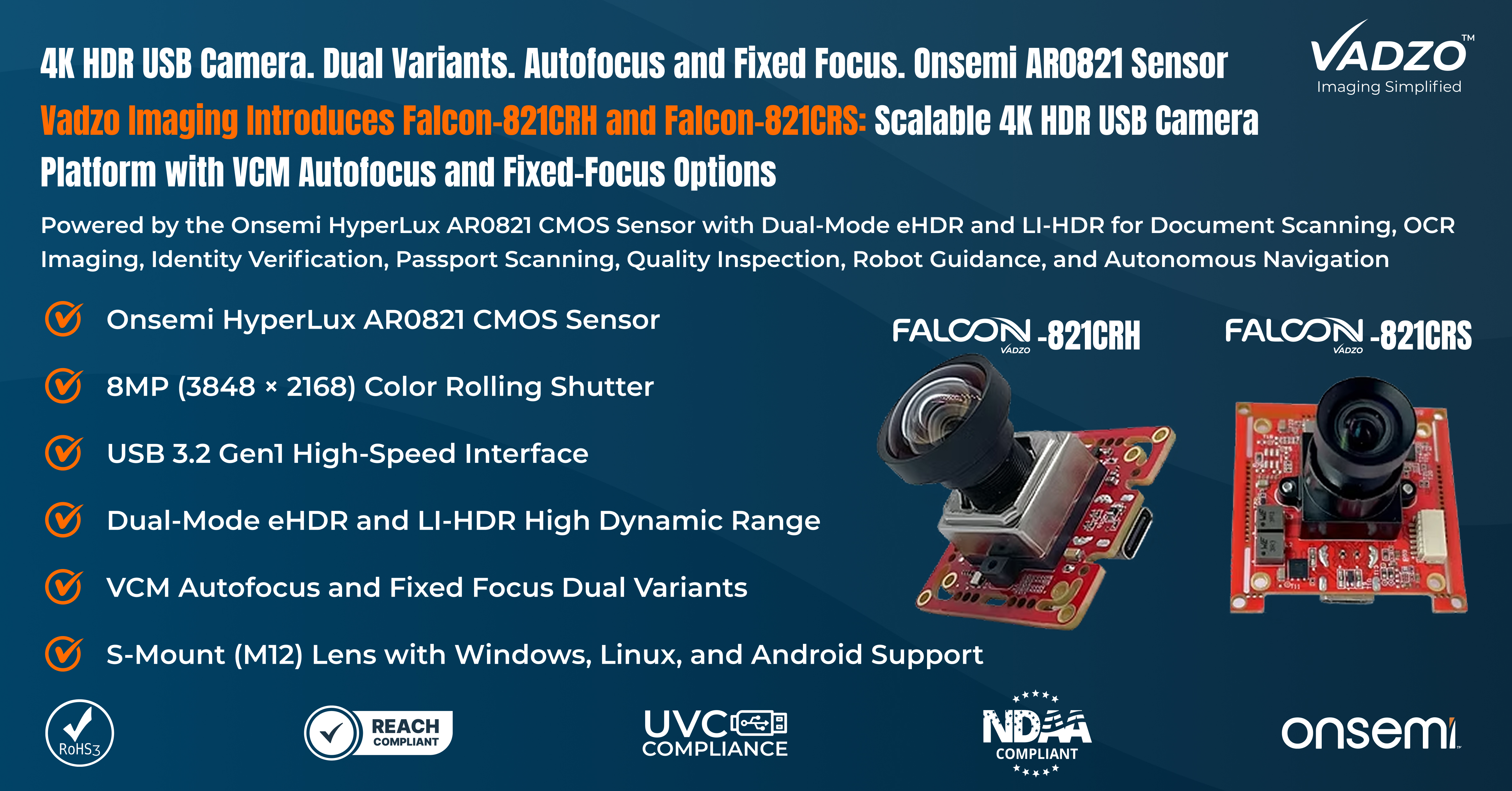
Sensor and Camera Overview
The Falcon-821CRS and Falcon-821CRH are 4K HDR USB Camera modules built on the Onsemi HyperLux AR0821 CMOS image sensor. The AR0821 is an 8MP (3848 × 2168) color rolling shutter sensor with a 1/1.7-inch optical format and 2.1 µm pixel pitch. It integrates two selectable HDR operating modes: eHDR and LI-HDR. The AR0821 eHDR Camera mode captures high dynamic range through a multi-exposure readout sequence at the sensor level, producing a tone-mapped output that preserves detail across both bright highlights and dark shadows simultaneously. The AR0821 LI-HDR Camera mode maintains a linear signal response across an extended exposure range, which is preferred in machine vision workflows where radiometric accuracy and pixel response consistency are required for OCR imaging, barcode reading, defect detection, and quality inspection algorithms. This dual-mode HDR architecture positions the AR0821 as a High Dynamic Range CMOS Camera capable of serving both perceptual output applications and radiometrically demanding machine vision pipelines from the same hardware platform.
The Falcon-821CRS is an AR0821 Fixed Focus Camera with a precision S-Mount (M12) lens calibrated to a defined working distance, making it appropriate for document scanning, OCR imaging, barcode reading, and identity verification deployments where camera-to-subject distance is controlled and repeatable. The Falcon-821CRH is an AR0821 VCM Autofocus Camera with a voice coil motor actuator that repositions the lens in real time to maintain focus across a variable working distance range, making it appropriate for robot guidance, pick and place automation, object tracking, and autonomous navigation applications where subject distance changes between frames. Both variants connect over USB 3.2 Gen1 as UVC-compliant devices and support full output at 8MP (3848 × 2168) with selectable 4K, 1080p, 720p, and VGA output modes. Native support for Windows, Linux, and macOS is provided without proprietary drivers.
Key specs – Falcon-821CRS: 8MP (3848 × 2168) | Onsemi HyperLux AR0821 | 1/1.7 inch | 2.1 µm pixel | Color | Rolling Shutter | Fixed Focus | eHDR and LI-HDR | USB 3.2 Gen1 | 8MP / 4K / 1080p / 720p / VGA | S-Mount (M12) | Windows, Linux, macOS
Key specs – Falcon-821CRH: 8MP (3848 × 2168) | Onsemi HyperLux AR0821 | 1/1.7 inch | 2.1 µm pixel | Color | Rolling Shutter | VCM Autofocus | eHDR and LI-HDR | USB 3.2 Gen1 | 8MP / 4K / 1080p / 720p / VGA | S-Mount (M12) | Windows, Linux, macOS
Key Capabilities of the Falcon-821CRH and Falcon-821CRS: Scalable 4K HDR USB Camera Platform
eHDR and LI-HDR: Two HDR Modes Covering Machine Vision and Perceptual Imaging Requirements: Most embedded vision deployments encounter one of two HDR requirements: perceptual wide dynamic range for visual output applications such as identity verification, passport scanning, and surveillance monitoring, or radiometrically accurate linear response for algorithmic processing in OCR imaging, barcode reading, and defect detection. Single-mode HDR camera architectures force system designers to choose between these objectives at the sensor selection stage, often requiring separate camera models for visual and machine vision functions within the same product program. The Onsemi HyperLux AR0821 integrates both eHDR and LI-HDR modes as selectable operating states within a single 4K eHDR USB Camera and 4K HDR Autofocus Camera platform. eHDR mode is appropriate for identity verification, passport scanning, and kiosk imaging, where scene tone mapping presents a natural, viewable output across high-contrast lighting. LI-HDR mode is appropriate for quality inspection, defect detection, OCR imaging, barcode reading, and document scanning, where downstream algorithms require a predictable, linear pixel response rather than a perceptually compressed output. This dual-mode capability allows the same 4K HDR USB Camera hardware to serve both visual and machine vision output tasks without hardware changes.
VCM Autofocus Architecture in the Falcon-821CRH for Dynamic Working Distance Applications: In robot guidance, pick and place automation, object tracking, and autonomous navigation, the distance between the camera and the subject is not fixed. Conveyor-fed part handling, collaborative robot workcells, and navigation cameras on mobile platforms all encounter changing camera-to-subject distances within a single operational cycle. A fixed focus USB camera configuration is unsuitable for these environments because the depth of field at a given aperture and focal length covers only a bounded working distance range. As the object moves outside that range, sharpness degrades, and feature extraction algorithms return unreliable results. The Falcon-821CRH addresses this constraint as an 8MP Autofocus USB Camera with a VCM actuator driven by continuous contrast-detection autofocus. The VCM repositions the lens element in real time, maintaining focus across the working distance envelope of the application without user intervention. This makes the Falcon-821CRH an appropriate autofocus imaging solution for automated optical inspection cells where parts arrive at variable heights, robot guidance systems where tool path geometry produces changing camera-to-workpiece distances, and autonomous navigation platforms where the tracked object distance changes continuously during approach.
Precision Fixed Focus Architecture in the Falcon-821CRS for Controlled-Distance Deployments: Document scanning, barcode reading, passport scanning, OCR imaging, and identity verification share a common imaging geometry: the subject is presented to the camera at a controlled, repeatable working distance. In these deployments, autofocus introduces unnecessary system complexity and potential capture latency. The focus hunt cycle consumes time that high-throughput applications cannot absorb, and the VCM actuator adds a mechanical component that contributes to long-term reliability risk in high-cycle industrial environments. The Falcon-821CRS operates as a precision AR0821 Fixed Focus Camera with its S-Mount (M12) lens calibrated to a defined working distance at the factory. This eliminates autofocus latency and removes the actuator from the reliability equation. The fixed focus imaging approach ensures frame-to-frame geometric consistency, which is a hard requirement for OCR imaging algorithms performing character segmentation, barcode reading engines processing narrow-pitch symbologies, and document scanning workflows relying on repeatable spatial resolution across successive frames.
4K Resolution and Multi-Mode Output for Scalable Vision Pipelines: Full 8MP (3848 × 2168) resolution capture delivers the spatial detail required for fine character recognition in OCR imaging, narrow-pitch barcode reading, and document scanning of small-font text. The AR0821’s 2.1 µm pixel pitch at 1/1.7-inch format provides sufficient pixel density to support sub-pixel feature detection at 4K HDR USB Camera output. Selectable output modes-8MP, 4K, 1080p, 720p, and VGA-allow the same embedded vision camera to operate at reduced bandwidth when system processing throughput or USB channel capacity makes full 8MP streaming unnecessary. This is applicable in autonomous navigation and robot guidance deployments where inference latency at 1080p or 4K is prioritized over maximum spatial resolution, while quality inspection, defect detection, and document scanning pipelines benefit from full 8MP output to resolve fine surface and character features. Both the autofocus USB camera and the fixed focus USB camera variants support the complete output mode range, maintaining consistency across the dual-variant scalable vision platform.
USB 3.2 Gen1 with UVC Plug-and-Play Integration Across Embedded Platforms: Both the Falcon-821CRS and Falcon-821CRH connect as UVC-compliant devices over USB 3.2 Gen1 (5 Gbps), providing plug-and-play recognition on Windows, Linux, and macOS hosts without proprietary drivers. This integration path applies directly to embedded computing platforms used in industrial and logistics automation, including NVIDIA Jetson Orin, Raspberry Pi 5, Rockchip RK3588, and standard x86 industrial PCs. The 5 Gbps USB 3.2 Gen1 bandwidth supports sustained 8MP streaming at supported frame rates without compression artifacts. For barcode reading tunnels, document scanning stations, and OCR imaging fixtures using Linux-based industrial PCs, UVC compliance removes the driver qualification step from the system integration timeline. System integrators can connect to the camera and immediately begin frame capture through standard V4L2, OpenCV, or GStreamer pipelines. The AR0821 camera module design is validated on standard USB 3.2 Gen1 host hardware, and evaluation kits include interface documentation and platform integration notes.
OEM Scalability Through Shared Sensor Architecture: The commercial case for a scalable vision platform rests on the engineering economics of sensor qualification. Qualifying a new image sensor for production involves driver development, image quality validation, environmental testing, and compliance certification-investments that scale with the number of distinct sensor platforms in a product portfolio. By anchoring both the Falcon-821CRS and Falcon-821CRH to the Onsemi HyperLux AR0821, Vadzo delivers two distinct focus architectures on a single qualified sensor baseline. OEM engineering teams building product lines that span fixed-distance and variable-distance imaging requirements-a document scanning station and a robot guidance system sharing a common sensor stack, for example-can use this OEM camera platform to reduce sensor qualification overhead while maintaining application-specific optical configurations. Both variants share the same AR0821 sensor lead time, inventory position, and sensor lifecycle, simplifying long-term supply chain management for volume deployments.
“The engineering challenge most OEM teams face when building products that span fixed-station document scanning and dynamic robot guidance is qualifying two separate sensors and maintaining two separate driver stacks. The Falcon-821CRS and Falcon-821CRH resolve that directly: the same AR0821 camera module architecture in fixed focus and autofocus configurations, with dual eHDR and LI-HDR modes that make both variants appropriate for perceptual imaging applications like identity verification and passport scanning, as well as algorithm-driven machine vision tasks like defect detection and barcode reading. For engineering teams building platforms that require document scanning, OCR imaging, robot guidance, or autonomous navigation, this 4K Dual Variant USB Camera approach reduces qualification overhead and keeps the product portfolio on a single sensor lifecycle.” – Alwin Vincent, Product Manager, Vadzo Imaging.
Applications
Document Scanning and OCR Imaging: High-throughput document scanning and OCR imaging require consistent spatial resolution and predictable per-frame exposure across every capture cycle. Character recognition algorithms depend on pixel-level sharpness, stable contrast, and linear pixel response conditions that autofocus latency and perceptual tone mapping can undermine in high-volume workflows. The Falcon-821CRS operates as an AR0821 Fixed Focus Camera with LI-HDR mode enabled, delivering a consistent, linearized 8MP image at each cycle with no focus-hunt delay and no tone-mapping artifacts. At full 8MP (3848 × 2168) resolution, this fixed focus USB camera resolves character strokes in small-font legal and financial documents at working distances calibrated to standard desktop and kiosk scanning geometries. For OCR imaging pipelines processing variable document types-identity forms, printed labels, and regulatory documents-the high spatial resolution and stable frame geometry of the fixed focus architecture eliminate per-frame geometric variability that would otherwise require preprocessing correction.
Identity Verification and Passport Scanning: Identity document capture for border control, employee onboarding, access management, and financial services requires consistent image quality under variable ambient lighting conditions. Kiosk and counter-mounted cameras encounter both backlit document presentations and directional overhead illumination that standard cameras cannot handle without dynamic range artifacts. The Falcon-821CRS, operating in eHDR mode, delivers a tone-mapped 8MP output that preserves MRZ and chip detail on identity documents even under high-contrast lighting. Passport scanning Applications benefit from the 4K spatial resolution and fixed focus calibration to a standard presentation distance, ensuring consistent MRZ character capture across document variants without per-session focus adjustment. The UVC-compliant USB 3.2 Gen1 interface integrates directly into kiosk controller platforms without custom driver development, reducing identity verification system deployment timelines considerably.
Barcode Reading and Logistics Automation: Industrial barcode reading in logistics, warehousing, and manufacturing requires high spatial resolution to decode narrow-pitch 1D and 2D symbologies at reading distances ranging from handheld scan range to tunnel-mounted fixed positions. The Falcon-821CRS, as a fixed focus USB camera calibrated to tunnel or conveyor working distances, delivers 8MP 4K resolution with LI-HDR active, producing consistent pixel response across reflective barcode labels, low-contrast printed codes, and mixed-surface packaging materials. The 4K spatial resolution enables reliable decoding of narrow-pitch PDF417, Data Matrix, and QR code symbologies that lower-resolution cameras misread under production throughput conditions. The 1080p and 720p output modes allow the same embedded vision camera to serve bandwidth-constrained logistics environments without requiring hardware replacement.
Quality Inspection and Defect Detection: Surface defect detection, inline color quality control, and dimensional measurement in PCB inspection, glass inspection, and precision manufacturing require an imaging platform with predictable spatial resolution, stable exposure, and consistent HDR behavior across production cycles. The Falcon-821CRS provides fixed focus imaging with LI-HDR mode and full 8MP output at calibrated working distances, delivering the frame-to-frame geometric repeatability and linear pixel response that quality inspection algorithms depend on. The 2.1 µm pixel pitch of the AR0821 at 1/1.7-inch format delivers sufficient spatial resolution to resolve sub-millimeter surface features at standard macro inspection working distances. Defect detection pipelines that process anomaly maps rely on pixel-level consistency. the fixed focus architecture eliminates inter-frame spatial variance that would produce false positives in high-throughput inspection environments.
Robot Guidance and Pick and Place Automation: Robotic vision systems performing pick and place automation, bin picking, and workpiece alignment encounter variable camera-to-subject distances as the robot arm approaches, grasps, and repositions components. The Falcon-821CRH addresses these constraints as a 4K Autofocus USB Camera with VCM-driven continuous focus, maintaining sharpness across the arm’s operating envelope without user intervention. The 8MP Autofocus HDR Camera resolution supports fine-feature registration on small components and printed circuit assemblies at close approach distances. The eHDR mode manages the reflective surface artifacts common in metal parts and PCB handling that fixed-exposure systems cannot resolve. Robot guidance and object tracking algorithms benefit from the combination of 4K spatial detail and continuous focus maintenance that the Falcon-821CRH provides across the full arm workspace.
Autonomous Navigation and Object Tracking: Autonomous mobile robots and guided vehicles in dynamic logistics environments require a forward-facing embedded vision camera that maintains focus on objects approaching at variable distances and captures usable imagery under mixed warehouse lighting, including skylights, artificial illumination, and shadow transitions. The Falcon-821CRH operates as a 4K HDR Autofocus Camera with continuous VCM focus adjustment and eHDR mode, maintaining sharp 8MP output across approach distances without manual refocus cycles. Autonomous navigation algorithms benefit from the consistent resolution output and the dynamic range preservation of eHDR, which prevents overexposed center-field and underexposed peripheral artifacts that degrade detection confidence in mixed-lighting environments. The USB 3.2 Gen1 interface delivers real-time 4K streaming directly to onboard ARM or x86 inference processors without compression overhead.
Frequently Asked Questions
Q: Which HDR mode should be selected for a barcode reading or OCR imaging system, and why does the choice matter?
A: Vadzo Imaging strongly recommends LI-HDR mode for any system where downstream algorithms process pixel intensity values directly-barcode reading engines, OCR character recognition pipelines, and defect detection classifiers all assume a linear relationship between pixel value and scene luminance. eHDR applies a tone-mapping curve that compresses highlight and shadow regions, which introduces non-linear pixel responses that degrade algorithm reliability when document brightness or label reflectivity varies between frames. LI-HDR preserves the linear response across an extended brightness range, enabling algorithms to perform consistently whether the document is illuminated by overhead directional light or ambient diffuse conditions. Vadzo Imaging’s 4K HDR USB Camera platform makes both eHDR and LI-HDR available as selectable parameters, so engineers can configure the correct HDR behavior without any hardware changes between production programs.
Q: How does VCM autofocus benefit systems that handle components at variable heights on a conveyor or in a bin?
A: In a pick and place automation or bin-picking cell where components arrive at variable heights, the camera-to-subject distance changes continuously during the robot’s approach and grasp cycle. A fixed focus configuration constrains the usable depth of field to a narrow working distance band. As the end effector descends or the object is lifted, the subject moves through progressively defocused zones where feature extraction algorithms return unreliable results. VCM autofocus repositions the lens element in real time as the contrast-detection algorithm identifies the distance of maximum sharpness, maintaining diffraction-limited spatial resolution throughout the robot’s operational range. Vadzo Imaging’s autofocus USB camera variant is specifically designed for this use case, providing continuous focus maintenance without adding a separate focus controller or host-side actuator driver to the system integration scope.
Q: Can the same application software run across both the autofocus and fixed focus variants without modification?
A: Yes. Both variants enumerate UVC-compliant USB 3.2 Gen1 devices and expose identical video streaming interfaces to the host operating system. Application code written against V4L2 on Linux, DirectShow or Media Foundation on Windows, or standard UVC to capture APIs on macOS operates identically across both models. The VCM autofocus in the autofocus variant runs as an onboard ISP function and does not require host-side driver interaction for standard continuous autofocus operation. OEM teams deploying both variants in a single product program, a fixed-station document scanning terminal and a mobile robot guidance system sharing a common software stack, for example, maintaining a single capture pipeline across both deployments. Vadzo Imaging’s scalable vision platform architecture is specifically designed to support this software portability requirement, reducing the firmware and integration of investment across multi-product programs.
Q: What spatial resolution is recommended for passport scanning and MRZ capture applications?
A: Full 8MP (3848 × 2168) output is recommended for passport scanning and identity verification applications where MRZ character capture, chip antenna imaging, and security feature detection require the highest available pixel density per unit document area. At 4K resolution, the AR0821’s 2.1 µm pixel pitch at 1/1.7-inch format provides sufficient angular resolution to capture standard ICAO passport MRZ characters across the expected range of camera-to-document working distances in kiosk and counter-mount configurations. Vadzo Imaging supports custom working-distance lens calibration for production deployments requiring optimized spatial resolution at specific fixed presentation distances, enabling OEM integration teams to meet ICAO resolution requirements with confidence.
Q: Does Vadzo Imaging provide platform integration support for specific edge AI and industrial computing boards?
A: Vadzo Imaging proudly delivers evaluation kits with platform integration documentation for standard embedded computing platforms used in industrial automation, including NVIDIA Jetson Orin, Raspberry Pi 5, and Rockchip-based industrial SBCs. UVC compliance ensures that frame capture works through standard V4L2 and GStreamer pipelines on all supported Linux platforms without proprietary driver development. For OEM engineering teams requiring integration support beyond standard UVC capture, custom ISP tuning, HDR mode configuration, autofocus parameter adjustment, or sensor-level access, Vadzo provides direct technical engagement. Production OEM customers can also request module-level driver customization and image quality tuning services. Contact Vadzo Imaging at support@vadzoimaging.com to discuss platform-specific integration requirements.
Availability
The Falcon-821CRS fixed focus USB camera and Falcon-821CRH autofocus USB camera, both built on the Onsemi HyperLux AR0821 sensor, are now available for evaluation and production orders. Evaluation kits for each variant include the camera module, S-Mount (M12) lens, USB 3.2 Gen1 cable, and platform integration documentation with no minimum order requirement. OEM engineering teams requiring custom lens configurations, modified operating temperature validation, or integration support for specific edge AI platforms may contact Vadzo to discuss application-specific requirements. Browse the full Vadzo embedded vision camera portfolio at https://www.vadzoimaging.com/ or contact Vadzo at support@vadzoimaging.com to request an evaluation kit or discuss volume pricing and OEM integration requirements.
About Vadzo Imaging
Vadzo Imaging is a global provider of embedded vision solutions delivering high-performance camera modules and imaging platforms for applications in robotics, industrial automation, UAVs, edge AI, medical systems, and smart infrastructure. Vadzo designs products for seamless integration with leading embedded platforms and supports customers through hardware customization, firmware development, and module-level driver enablement, facilitating faster development and deployment of vision-based systems.
Media Contact
Alwin Vincent
Vadzo Imaging
Email: alwin@vadzoimaging.com
LinkedIn: Vadzo Imaging
YouTube: Vadzo Imaging
X: Vadzo Imaging
SOURCE: Vadzo Imaging
View the original press release on ACCESS Newswire


