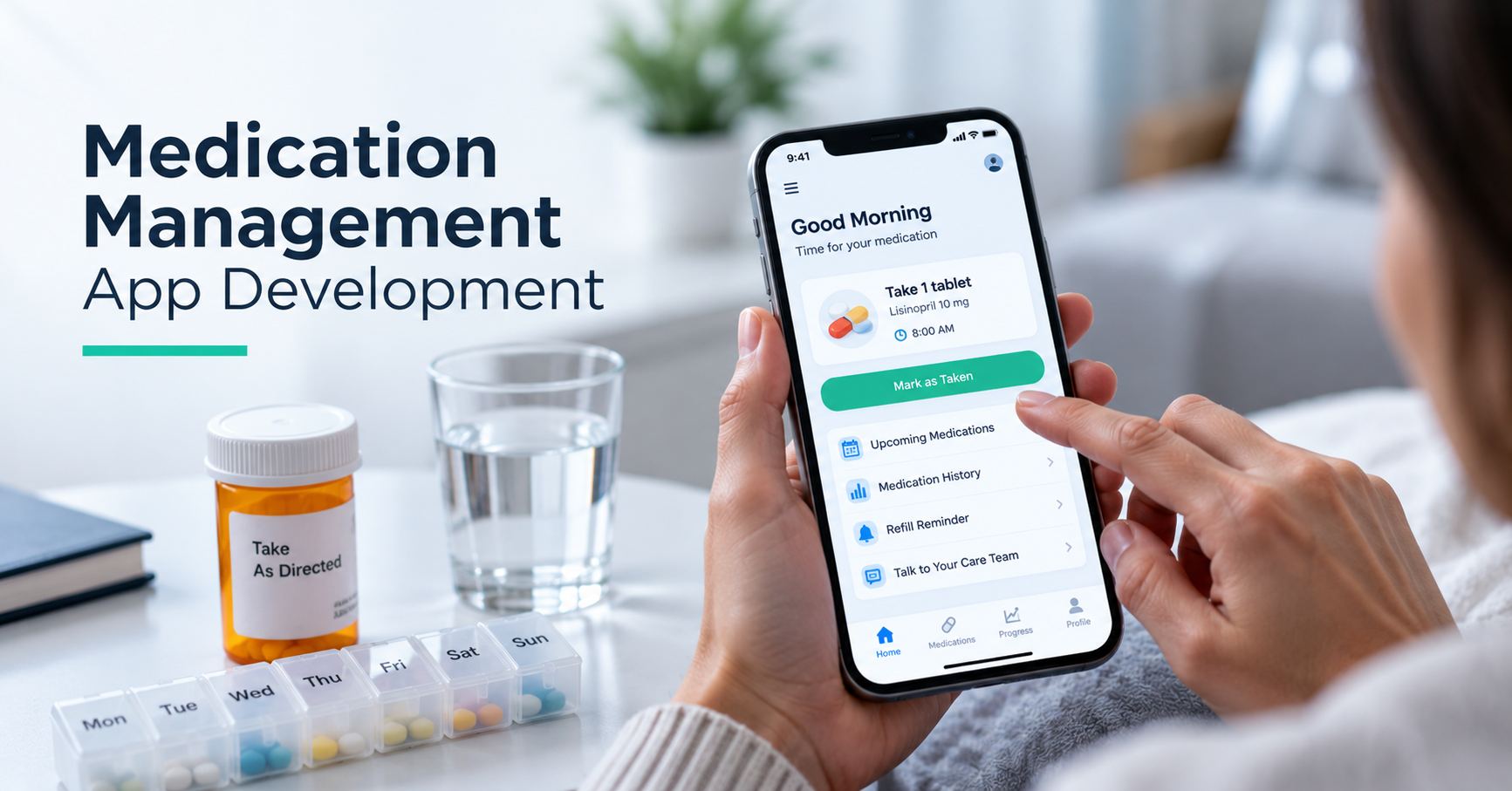
The healthcare IT company outlines how medication reminders, adherence tracking, and EHR integration can support more connected care.
CHICAGO, IL, UNITED STATES, September 9, 2026 /EINPresswire.com/ — Taction Software, a healthcare IT company providing custom software development, interoperability, and digital health solutions, is highlighting the importance of connected medication management applications as healthcare organizations seek to improve medication-related workflows, patient engagement, and coordination across care settings.
Medication management is often discussed as a patient reminder problem. In practice, it can involve a much broader set of activities: maintaining an accurate medication list, communicating prescription changes, supporting refill requests, recording adherence information, connecting with pharmacy systems, and making relevant information available to care teams. When these activities are spread across disconnected applications and manual processes, organizations may have limited visibility into what happens between a prescription and the next clinical encounter.
Taction Software’s approach to medication app development focuses on the workflows, integration requirements, and security considerations that determine how an application fits into a healthcare organization’s existing technology environment. The company emphasizes that a medication app should be planned as part of a connected care process rather than treated only as a standalone mobile product.
Medication Management Is More Than a Reminder
A medication reminder can help a patient remember when a dose is scheduled, but it does not necessarily answer what happens when the patient misses a dose, changes medication, needs a refill, or receives conflicting information from different sources. These situations illustrate why medication management applications may require more than notifications and a calendar.
Depending on the intended users and clinical setting, an application may need to support medication schedules, refill reminders, adherence records, educational information, and communication with healthcare professionals. Some projects may also require integration with EHR systems, pharmacy platforms, medication databases, or other digital health services.
The appropriate feature set depends on the organization’s objectives. A patient-facing reminder application, a medication adherence platform, and a clinician-supported medication management system may have different requirements, even when they share similar interface elements.
Taction encourages healthcare organizations to define the intended workflow before selecting features. This includes identifying who enters medication information, who can update it, how changes are communicated, and what happens when information is incomplete or unavailable.
“Medication management technology should be designed around the real workflow, not just the reminder screen,” said Arinder Singh Suri, CEO of Taction Software. “The important questions are what information patients need, what care teams need to see, and how the application connects with the systems already involved in care.”
The Challenge of Disconnected Medication Information
Healthcare organizations frequently operate multiple systems that serve different purposes. An EHR may contain clinical documentation and medication orders, while a pharmacy platform manages dispensing information and a patient-facing application provides reminders or educational content. These systems do not automatically share the same information or update at the same time.
For a medication application, this creates important design questions. Which system is the authoritative source for a medication list? How should prescription changes be reflected in the app? What information can be displayed to the patient? How should the application respond when an integration is unavailable or a record cannot be matched?
These questions are not simply technical details. They influence the reliability of the workflow and the experience of the people using the application. A system that displays outdated information or fails to communicate an important change may create confusion, even if its reminder functionality works as designed.
Taction’s broader healthcare IT capabilities include EHR and EMR integration, interoperability, custom application development, and healthcare data security. The company’s medication app development approach therefore considers how the application will exchange information with existing systems and how those exchanges will be maintained over time.
Designing Around the Patient Journey
Medication management applications can support different stages of the patient journey, from receiving a prescription to managing an ongoing treatment schedule. However, the needs of patients may vary considerably depending on the condition being treated, the complexity of the medication regimen, and the level of support available from caregivers or healthcare professionals.
A useful application should make essential information understandable and accessible without overwhelming the user. This may involve clear medication schedules, readable instructions, straightforward navigation, and notifications that can be configured according to the intended workflow.
Accessibility and usability are also important considerations. Patients may have different levels of digital literacy, visual ability, language preference, or familiarity with healthcare terminology. A development team should consider these factors during requirements gathering and usability testing rather than assuming that a single interface will work equally well for every user.
For organizations serving patients with complex medication regimens, the application may also need to account for multiple medications, changing schedules, or caregiver involvement. These requirements should be evaluated carefully because they can affect both the user experience and the underlying data model.
The goal is to create an application that supports the intended medication workflow while making it clear when users should contact a healthcare professional or follow established clinical instructions.
Supporting Care Teams Without Creating More Work
Patient-facing technology can create new operational demands if it is not connected to the processes used by care teams. For example, an application may collect adherence information or generate alerts, but the organization must determine who is responsible for reviewing that information and what action, if any, should follow.
Taction recommends defining these responsibilities before implementation. If an application sends information to a clinical system, the project team should understand where that information appears, who can access it, and how it fits into existing workflows.
Not every notification requires clinical intervention, and not every piece of patient-generated information should become an urgent task. The design should distinguish between routine information, exceptions requiring review, and situations that should direct the patient to established care channels.
This approach can help organizations avoid building applications that collect information without a clear operational purpose. It also supports more realistic planning for staffing, monitoring, and ongoing application support.
EHR and Pharmacy Integration Considerations
Integration requirements can significantly influence the scope of a medication management project. An application that operates independently may have a different architecture from one that must exchange information with an EHR, pharmacy platform, or other healthcare system.
Depending on the project, integration may involve APIs, HL7 or FHIR-based interoperability, medication data services, or other supported interfaces. The specific approach depends on the systems involved, the information being exchanged, and the technical capabilities available.
Before development begins, organizations should identify the systems that need to connect, the data required for each workflow, and the expected direction of information exchange. They should also consider how authentication, authorization, error handling, and monitoring will be managed.
Data mapping is another important consideration. Medication information may be represented differently across systems, and the application must be designed to handle the formats and terminology relevant to its intended use.
Taction’s healthcare interoperability experience allows these integration questions to be considered alongside application design, rather than being treated as an afterthought after the user interface has been completed.
Exception Handling Should Be Part of the Design
Medication workflows can include exceptions such as missing information, unavailable systems, failed data exchanges, duplicate records, or changes that require manual review. These situations should be considered during planning because they can affect how the application behaves in real-world use.
An exception-first approach begins by identifying known failure scenarios and determining how the application should respond. For example, the system may need to display a clear message when information cannot be retrieved, preserve an appropriate audit record, or route an issue to a designated support process.
The objective is not to eliminate every manual step. It is to make exceptions visible and manageable so that users and support teams understand what has happened and what should happen next.
Taction encourages organizations to review exception handling during testing and after deployment. Real-world usage may reveal additional edge cases that were not apparent during initial requirements gathering, making ongoing monitoring and process refinement important parts of the application lifecycle.
Security and Privacy Requirements
Medication management applications may process sensitive health information, making security and privacy central considerations during development. The applicable requirements depend on the application’s intended use, the organizations involved, the data being handled, and the jurisdictions in which the application operates.
For projects subject to HIPAA, development planning may need to address appropriate administrative, physical, and technical safeguards, as well as contractual requirements such as business associate agreements where applicable.
Technical considerations may include access controls, encryption, audit logging, secure authentication, data retention, and procedures for managing security incidents. The specific controls should be determined through a risk-based assessment of the application and its environment.
Organizations should also consider how third-party services are used. A medication app may rely on cloud infrastructure, messaging providers, analytics services, or external APIs. Each dependency should be evaluated according to the information it processes and the security requirements of the project.
Taction’s healthcare IT approach incorporates security and compliance considerations into the development lifecycle rather than treating them as a final-stage checklist.
Regulatory Scope Depends on Intended Use
Not every medication application has the same regulatory requirements. A basic reminder application may have a different regulatory profile from software that provides clinical recommendations, calculates medication doses, or performs functions that could fall within medical device regulation.
Organizations should define the intended use of the application early and assess whether additional regulatory requirements may apply. Depending on the functionality and market, this may include consideration of FDA software-as-a-medical-device requirements or other relevant regulatory obligations.
Taction encourages healthcare organizations to involve appropriate clinical, legal, and regulatory stakeholders when defining these requirements. Development decisions should be based on the intended functionality and applicable rules rather than assuming that all healthcare applications are regulated in the same way.
This assessment can influence architecture, documentation, testing, validation, and release planning.
Building for Different Healthcare Organizations
Medication management technology may be relevant to healthcare providers, pharmaceutical companies, digital health businesses, and other organizations involved in medication-related services. However, the requirements of each project can differ substantially.
A healthcare provider may prioritize integration with existing clinical systems and patient communication workflows. A digital health company may focus on a scalable patient-facing platform with configurable features and external integrations. A pharmaceutical organization may have different requirements related to patient support programs, information delivery, or engagement.
Taction’s custom development approach begins with the organization’s specific objectives rather than assuming that one application model is suitable for every use case.
This includes identifying the intended users, defining the core workflows, reviewing existing technology, and determining which capabilities are necessary for the initial release. Additional features can then be evaluated according to business priorities, technical dependencies, and user feedback.
Planning the Development Lifecycle
A medication app project typically begins with discovery and requirements analysis. During this stage, the organization and development team define the intended users, workflows, integration needs, security requirements, and project objectives.
The next stage may involve user experience design, technical architecture, and development planning. These activities help establish how the application will function and how it will connect with other systems.
Development and testing should then address both routine workflows and exception scenarios. Depending on the project, testing may include functional testing, integration testing, security testing, usability evaluation, and other validation activities appropriate to the intended use.
Deployment is not the end of the process. Applications may require monitoring, maintenance, updates, and support as operating systems, external services, and organizational requirements change.
Taction emphasizes that these lifecycle considerations should be included in project planning so that organizations understand the responsibilities associated with operating the application after launch.
Understanding Medication App Development Costs
The cost of developing a medication management application depends on its scope and complexity. A focused application with basic scheduling and reminder functionality may require a different investment from a platform that includes EHR integration, pharmacy connectivity, advanced reporting, or multiple user roles.
Other factors may include the number of supported platforms, user experience requirements, third-party services, security controls, testing needs, and ongoing maintenance.
Organizations should therefore avoid treating a single published price as a definitive estimate for every medication app project. A meaningful estimate requires an understanding of the intended functionality and the systems with which the application must interact.
Taction recommends beginning with a requirements assessment and prioritizing the capabilities needed for the initial release. This can help organizations distinguish essential functionality from features that may be appropriate for later phases.
A 360° Healthcare IT Perspective
Medication management applications illustrate why healthcare technology projects often require capabilities beyond mobile app development alone. A successful implementation may involve software engineering, interoperability, cloud infrastructure, security, user experience, and ongoing operational support.
Taction Software’s 360° healthcare IT positioning reflects this broader view. The company provides services across custom healthcare software development, EHR and EMR integration, healthcare AI, mobile and web applications, and related technology areas.
For organizations planning medication technology, this means the application can be evaluated in the context of the wider healthcare environment. The objective is to understand how the solution will connect with existing systems, support intended workflows, and remain maintainable as requirements evolve.
The company encourages healthcare organizations to approach medication app development as a connected technology initiative rather than a collection of isolated features.
Looking Ahead
As healthcare organizations continue to invest in digital health, medication management applications may become part of broader patient engagement and care coordination strategies. Their value will depend on how well they support the intended users and fit into the systems and processes already used by healthcare organizations.
Taction Software is highlighting the need for early workflow planning, clear integration requirements, appropriate security controls, and realistic operational responsibilities. These considerations can help organizations make more informed decisions about the scope and implementation of medication management technology.
Healthcare providers, pharmaceutical companies, and digital health businesses can explore Taction Software’s Medication Management App Development services to learn more about its capabilities and discuss project requirements.
About Taction Software
Taction Software is a healthcare IT company providing custom healthcare software development, EHR and EMR integration, interoperability, healthcare AI, and mobile and web application development. The company works with healthcare organizations and digital health businesses to build, integrate, and modernize technology supporting clinical and operational workflows.
For more information, visit Taction Software.
Media Contact
Taction Software LLC
arinder singh suri
Taction Software LLC
307-459-0850
email us here
Visit us on social media:
LinkedIn
Instagram
Facebook
YouTube
X
Other
Legal Disclaimer:
EIN Presswire provides this news content “as is” without warranty of any kind. We do not accept any responsibility or liability
for the accuracy, content, images, videos, licenses, completeness, legality, or reliability of the information contained in this
article. If you have any complaints or copyright issues related to this article, kindly contact the author above.

Media gallery